Amazon Vine: what it costs, and what the reviews actually do
Amazon Vine sends your product free to reviewers Amazon invited, called Vine Voices, who post an honest review in return. Enrolling costs nothing for up to two units, $75 for three to ten, and $200 for eleven to thirty. You need Brand Registry, FBA, and a listing with fewer than 30 reviews.
Key takeaways
- Vine is Amazon's own review program, not a third-party service. Amazon invites the reviewers and keeps them anonymous.
- The price is charged per parent product, and child products cost nothing extra. Up to 2 units is free, 3 to 10 is $75, and 11 to 30 is $200.
- Nothing is billed in the first 30 days, and nothing is billed until a Vine review has gone live. Go 90 days with no review and the fee is never charged.
- The "fewer than 30 reviews" rule is a gate on getting in, not a cap on reviews you receive.
- Once a Voice has claimed a unit you cannot cancel, and stopping enrollment does not guarantee the review will not publish.
What is the Amazon Vine program?
Amazon's own way of getting reviews onto a listing that has few or none, including before it launches.
Amazon describes Vine as a program that helps sellers collect high-quality reviews, even ahead of a launch. You enroll a product and set aside a number of units. Amazon then offers those units to reviewers it has invited into the program, the Vine Voices. They receive the product at no charge, and give an honest, unbiased opinion in a review.
The reviewers are not volunteers who signed up, and that is the first thing to get straight. Amazon picks Voices on how insightful their published reviews in its store have been. There is no application form: an invitation comes from Amazon or it does not come at all. Amazon also keeps a Voice's identity private, and gives that privacy as its reason for shipping every Vine product through FBA.
Two more assumptions about Voices are worth correcting. They are not paid for writing, and while the product itself is free to them, Amazon states that income tax on it is theirs to handle. They also pick which enrolled products to request, so your enrollment is an offer on a shelf rather than a parcel already addressed.
Who can enroll a product in Amazon Vine?
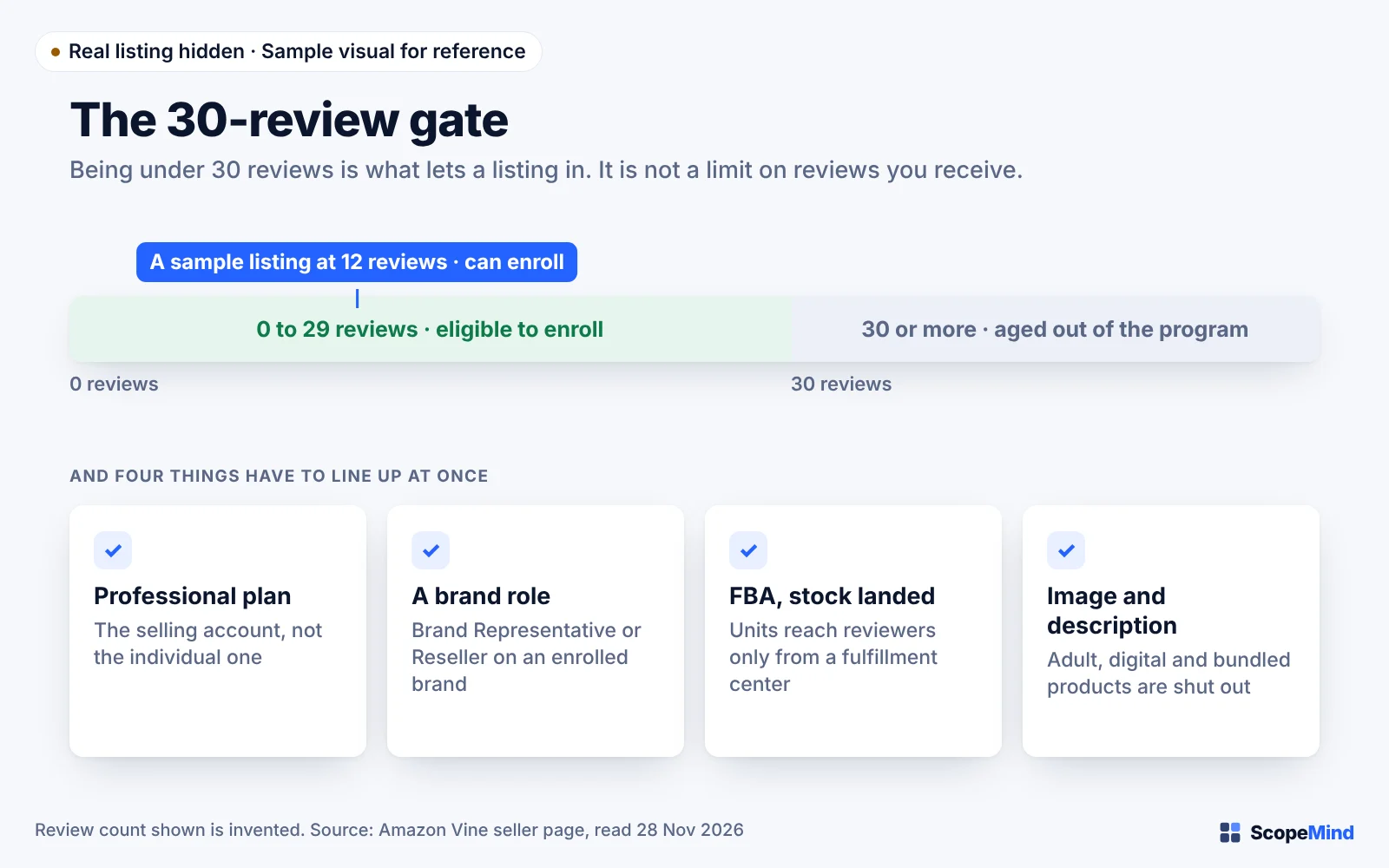
Four things have to line up at once: the account, the brand role, FBA, and a listing still under 30 reviews.
The Vine requirements start with the account. Amazon wants a Professional selling account, and it wants you holding either the Brand Representative or the Reseller role on a brand you have enrolled in Brand Registry. Sellers whose catalog holds generic products are named as eligible too. Not enrolled yet? Our guide to enrolling in Amazon Brand Registry covers what that takes.
Then the product itself. The listing has to be fulfilled by FBA, and the stock has to actually travel. Amazon is explicit that units reach Voices only once your FBA inventory has landed at its fulfillment centers. The detail page needs an image, a description, and fewer than 30 reviews on it already. Adult, digital and bundled products are shut out altogether.
The review threshold is worth reading twice, because it works in the opposite direction to how it sounds. Being under 30 reviews is what makes an ASIN eligible to enroll. It sets no limit on how many reviews Vine then produces. An ASIN that has climbed past 30 reviews on its own has simply aged out of the program. If the code itself is new to you, we cover what an ASIN is separately.
Two numbers sellers expect at this point do not exist. Amazon publishes no minimum stock quantity and no minimum review count, so there is no bar to clear before you qualify.
What does Amazon Vine cost?
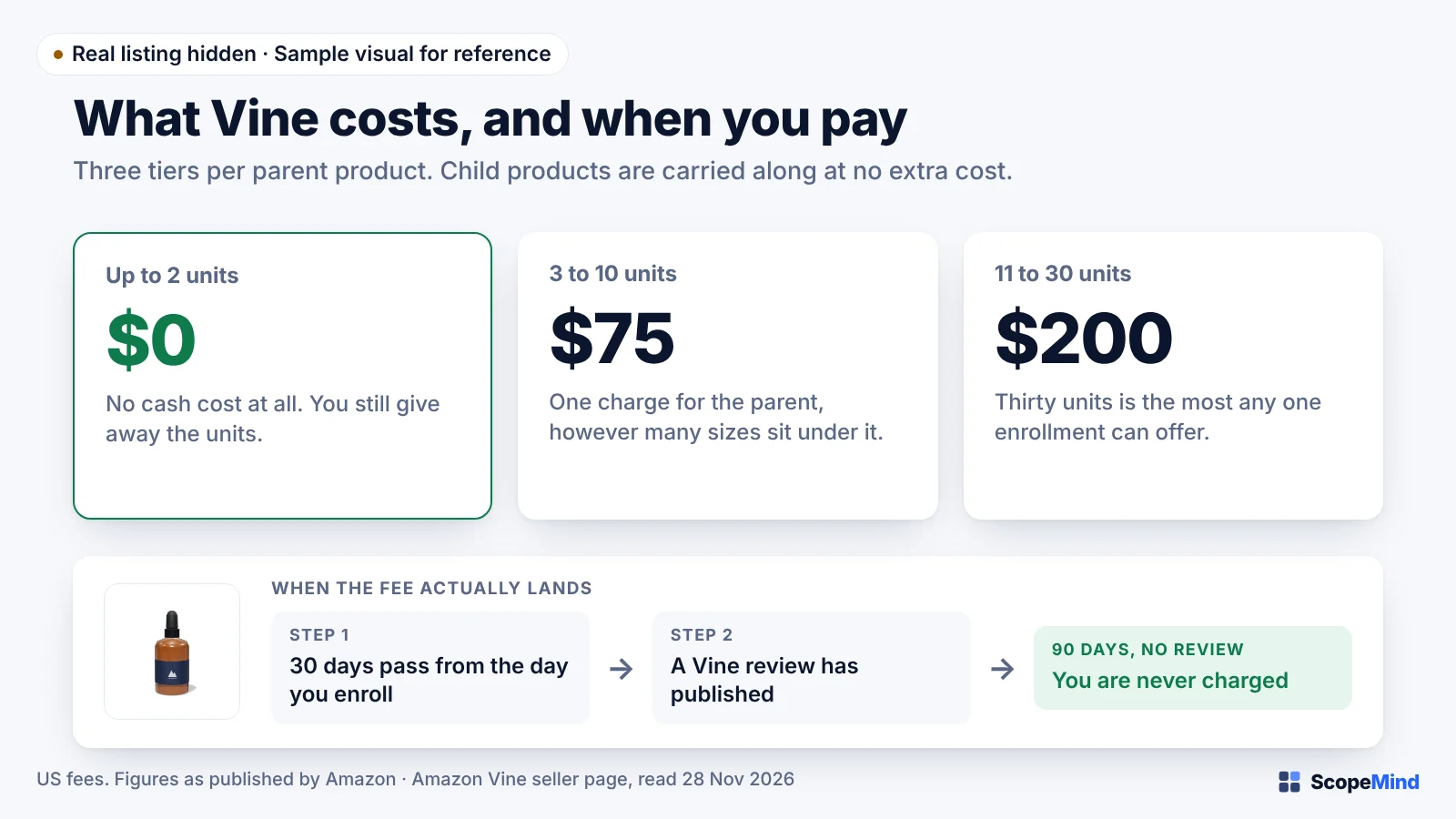
Three tiers, charged per parent product, with child products included at no extra cost.
| Units you make available | Cost per parent product |
|---|---|
| Up to 2 | $0 |
| 3 to 10 | $75 |
| 11 to 30 | $200 |
All three tiers are Amazon's own published US enrollment fees. The two paid tiers carry their own prices in other stores. Canada is CAD 100 and CAD 240, the UK GBP 60 and GBP 140, the EU EUR 70 and EUR 170, and Japan JPY 10,000 and JPY 22,000. The fee attaches to the parent, so a listing with six sizes is one charge rather than six.
The billing rules matter more than the sticker price. Amazon holds the charge for a month from the date you enroll, and will not raise it until a Vine review has actually published. Three months with no Vine review at all, and the fee never lands.
That is a different risk shape from a flat fee paid upfront. The free tier costs nothing in cash whatever happens, so the real outlay is the stock. Say you sell a product for $40: ten units is $400 of inventory out the door before the $75 fee is counted at all. Budget the units, not the fee.
One more cost sits underneath all of this, and it is not a Vine charge. The Professional selling account that Vine depends on carries a monthly price of $39.99, plus the usual selling fees.
How do you enroll in Vine, step by step?
How to join the Vine program comes down to five steps, and the enrollment itself sits on the Vine dashboard under the Advertising menu in Seller Central.
- Get on a Professional selling plan. Sign in to Seller Central on the Professional plan, or sign up for one.
- Sort out the brand role. Enroll the brand in Brand Registry, or obtain the Brand Representative or Reseller role.
- Move the listing onto FBA. Sign up for FBA, then set that listing's inventory to be fulfilled by Amazon.
- Enroll the product and pick your units. A product that has not launched can go in once its FBA listing is ready for customers and a launch date is set ahead. One already selling can go in while its review count is still below 30. The dashboard lets you commit as many as 30 units.
- Watch the dashboard. Enrollment status, claimed quantity and reviews are all reported there.
The timing advice is the useful part for a launch. The listing does not have to be live, and the stock does not have to have landed: an FBA listing is enough to enroll. Amazon's own suggestion is to be enrolled, with stock already inside its network, a minimum of three weeks ahead of the day you mean to launch.
What can go wrong once you enroll?
The commitment runs one way: before a unit is claimed you can back out, and after one is claimed you cannot.
As long as nothing has been claimed, the enrollment can be cancelled and set up again another time. Once units are claimed, cancelling is off the table. You can stop the enrollment, but Amazon warns that reviews for already-claimed units may still appear, and once stopped, that product cannot be enrolled again.
So the honest answer to "what if they hate it" is that the reviews are not yours to take back. The program runs on unbiased opinion, which means a weak product collects an accurate verdict in public, on the very page your launch advertising is about to point at. Fix the product or the packaging first. Enroll second.
The volume is not promised either. Enrollment lets you put up to 30 units on the shelf, yet Amazon's page commits to no review count and no star rating, and Voices take what they choose. A 30-unit enrollment can finish with far fewer reviews than units.
Then there is the gap between what Amazon publishes and what a seller would like to know. Its Vine page is silent on three things in particular. It does not say how quickly a Voice gets round to claiming or reviewing. It does not say whether a fee is ever refunded or adjusted when the reviews fail to arrive. And it does not say what contact with a Voice is permitted. Pages ranking for this topic fill that silence with review-count expectations and star-rating targets of their own. Treat those as other people's reporting, and read your own Vine dashboard and Amazon's review policies before you plan around them.
Amazon's Vine page gives no menu path beyond the Advertising menu, and no timeline for a review arriving. Check your own Vine dashboard rather than copying a schedule out of a blog post, this one included.
How do you tell whether Vine actually worked?
By writing down what the listing looked like before the reviews landed, because afterwards there is no way to reconstruct it.
Start with the figure everyone quotes. Amazon's Vine page headlines an average sales boost of 30%, with a footnote crediting Amazon internal data. It arrives without a methodology, a sample size or a time period. That makes it the program owner's own number rather than an independent finding, and not a forecast for your product.
The harder problem is the timing. Amazon suggests enrolling around three weeks before launch, so the reviews tend to arrive in the same stretch as everything else a launch sets in motion. In a typical launch that means advertising switching on, a price still settling, stock levels moving and competitors responding. Measure sales before and after that window and Vine gets the credit for all of it.
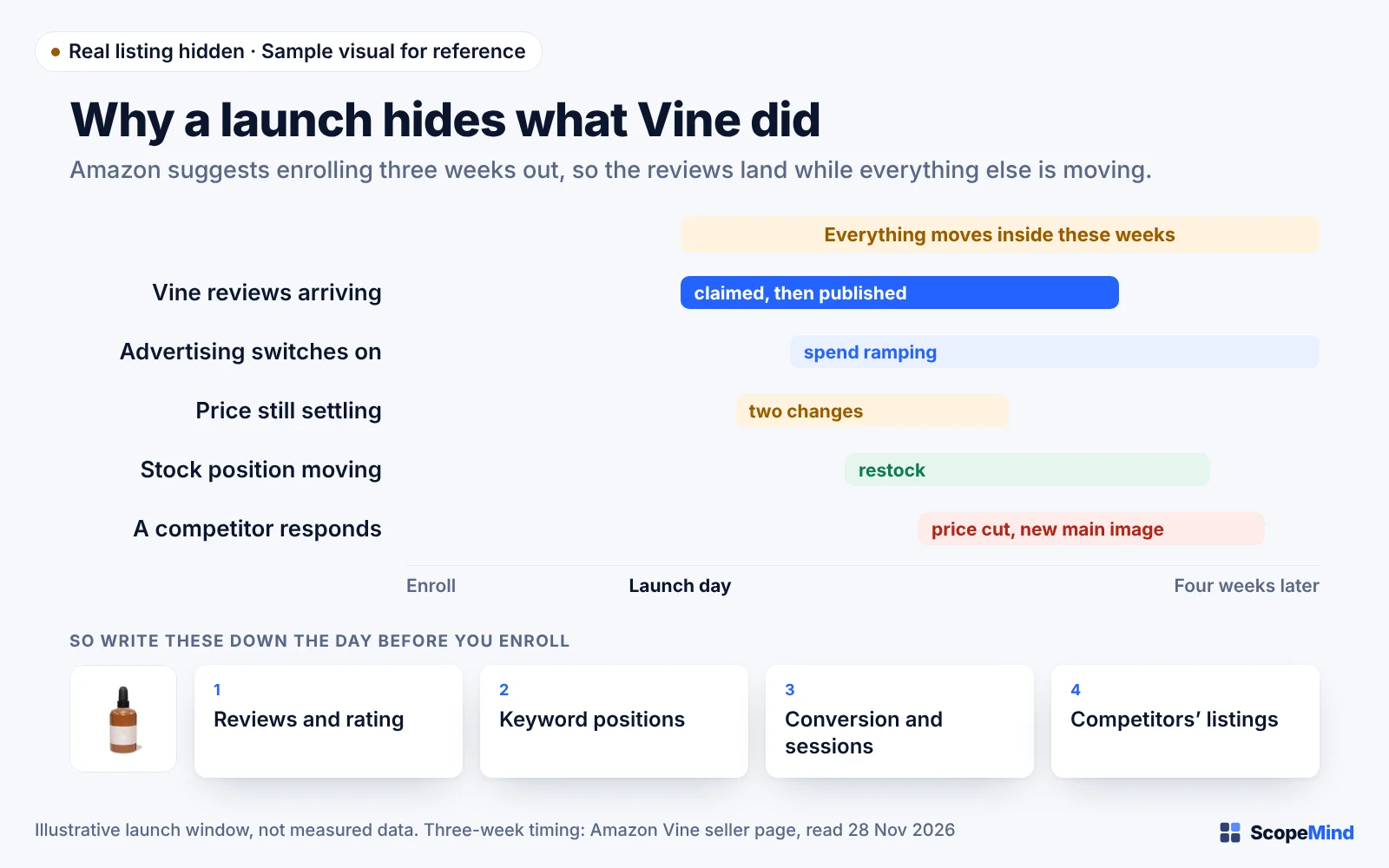
Separating Vine's effect from the rest needs a baseline recorded in advance. It cannot be reconstructed later. Four things are worth writing down the day before you enroll:
- Review count and star rating. This is what tells you what the Vine reviews added, and what they did to your average.
- Your position on the keywords you care about. Reviews are supposed to change how shoppers behave on the page, and rank is where that eventually shows.
- Conversion rate and sessions. A review effect usually turns up here before it turns up in rank.
- What the competing listings on those keywords looked like. A rival may have cut a price or swapped a main image in the same week. That is an alternative explanation for your own numbers moving.
The fourth one is the easiest to leave out, and the one that makes the other three readable. That is the job ScopeMind does: it records every change on the listings you track, yours and your competitors', on a single timeline. When sales move, you can see whether the reviews landed or someone else moved first. Our guide to watching what competitors change explains the habit. If rank is the number you are watching, what a good Best Sellers Rank looks like is the companion piece.
Frequently asked questions
- Is the Amazon Vine program worth it?
- That rests on the product more than the price. The fee is small next to the stock you give away, and nothing is charged unless a review actually publishes. The catch is that opinions are unbiased and cannot be pulled once a unit is claimed, so Vine repays a product that is already good.
- How much does Amazon Vine cost?
- Per parent product: nothing for up to 2 units, $75 for 3 to 10, and $200 for 11 to 30, with child products carried along free. Amazon waits a month from enrollment and a published review before charging, and drops the fee entirely if three months pass with no review.
- How many reviews do you get from Amazon Vine?
- Up to 30 units can be offered per enrollment, but Amazon promises no particular number of reviews in return. Voices choose what to request, so units can sit unclaimed, and a claimed unit is not a guaranteed review.
- Can you cancel an Amazon Vine enrollment?
- Only while every unit is still unclaimed, and then you may enroll again later. After units are claimed you can stop the enrollment but not cancel it, reviews for those units may still publish, and that product cannot be re-enrolled.
- Does Amazon pay you to be a Vine reviewer?
- No. A Voice receives the product itself free and gives an honest opinion back, with no payment involved. Amazon states that any income tax on the product is the reviewer's own responsibility. It chooses Voices by how insightful their published reviews have been.
- Can I use Vine on a product that already has reviews?
- Yes, provided the detail page is still below 30 reviews and carries an image and a description. Once a listing has gathered 30 or more reviews, it can no longer be enrolled.
Know whether the reviews moved anything
Record what your listing and your competitors' listings looked like before the reviews landed, so the lift you measure afterwards is Vine's and not the launch around it. ScopeMind tracks every change on the products you watch, so a competitor's price cut in your launch week does not get filed as your own result.
Start tracking your listings