A competitor cut their Amazon price for Black Friday: match, ignore or out-position?
When an Amazon competitor cuts their price for Black Friday, do not match it on reflex. Watch your own rank for a few days first. Match only if you share the same product page or your rank keeps falling. Otherwise ignore a short sale, or out-position it with a better image, title or coupon.
Key takeaways
- A Black Friday price cut is usually temporary. Many end when the event ends.
- Judge the cut by what it does to your rank and sales, not by the size of the discount.
- Match when you share the same product page or your rank keeps falling for most of a week.
- Ignore a short sale that leaves your rank steady.
- Out-position with something shoppers can see: the main image, the title, a coupon or a bundle.
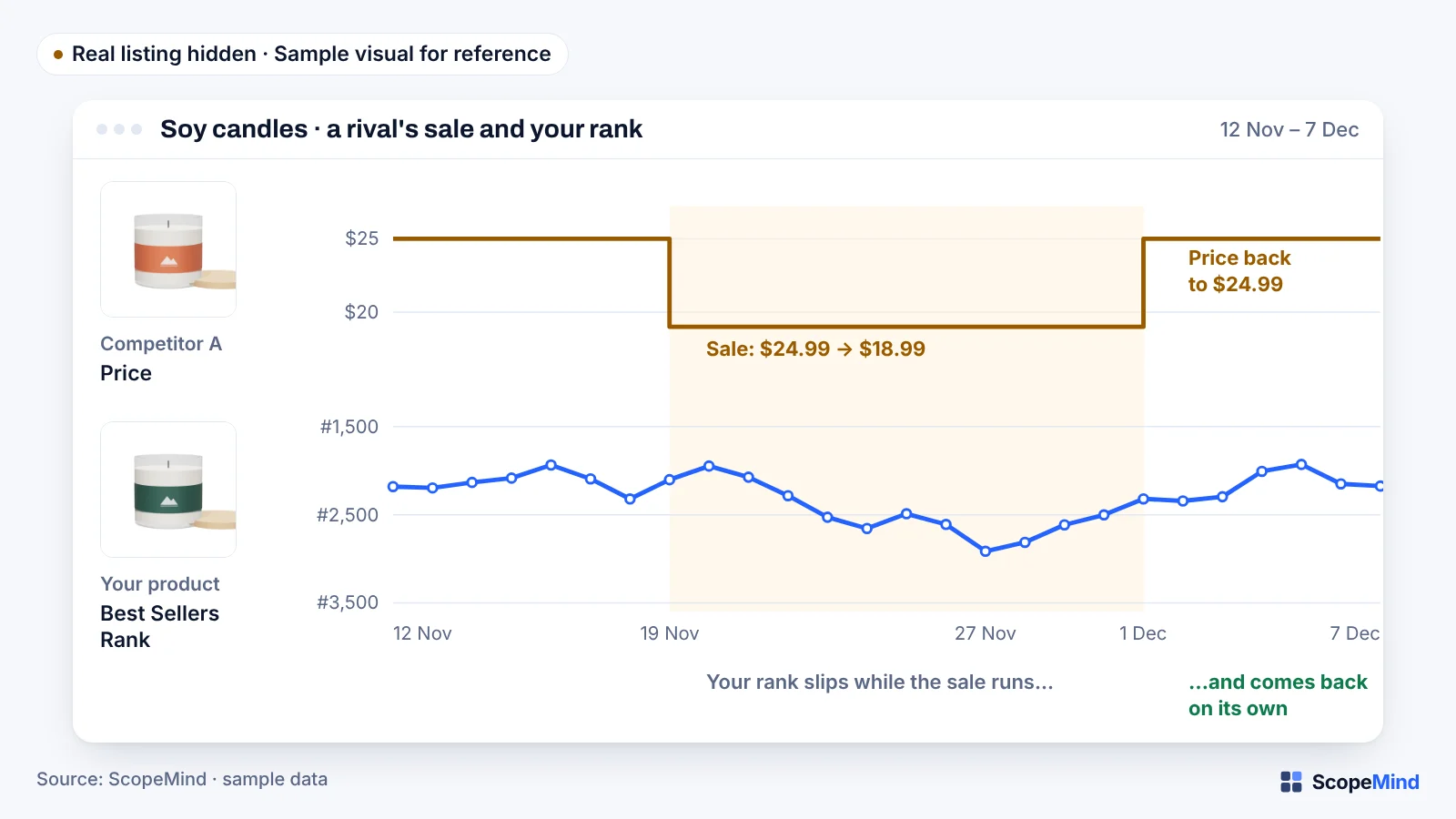
Why do Amazon competitor prices go up and down around Black Friday?
Sellers cut prices to win the extra shoppers of the sale week, then put them back when the traffic drops.
In 2026 Black Friday is on Friday 27 November, and Amazon's US Black Friday Week runs from 19 November to Cyber Monday, 30 November. So a rival's price often drops a week before the day itself and returns in early December.
Some cuts are set by hand for the event. Others come from repricing rules that follow the lowest price on the page, which is why one seller's cut can set off a chain of small cuts across a niche within hours.
Should you react straight away?
No. Give it a few days and watch what the cut does to your own rank and sales.
A discount you can see is not the same as a loss you can measure. If your Best Sellers Rank wobbles but stays at its usual level, the cut is not taking your buyers, and matching it would only give away margin. If your rank falls day after day for most of a week, the cut is working against you and you need an answer.
Write down three things the day you notice the cut: their old and new price, your rank and your units sold. Compare the same three each day. That small log decides the next step for you.
Match, ignore or out-position: which one fits?
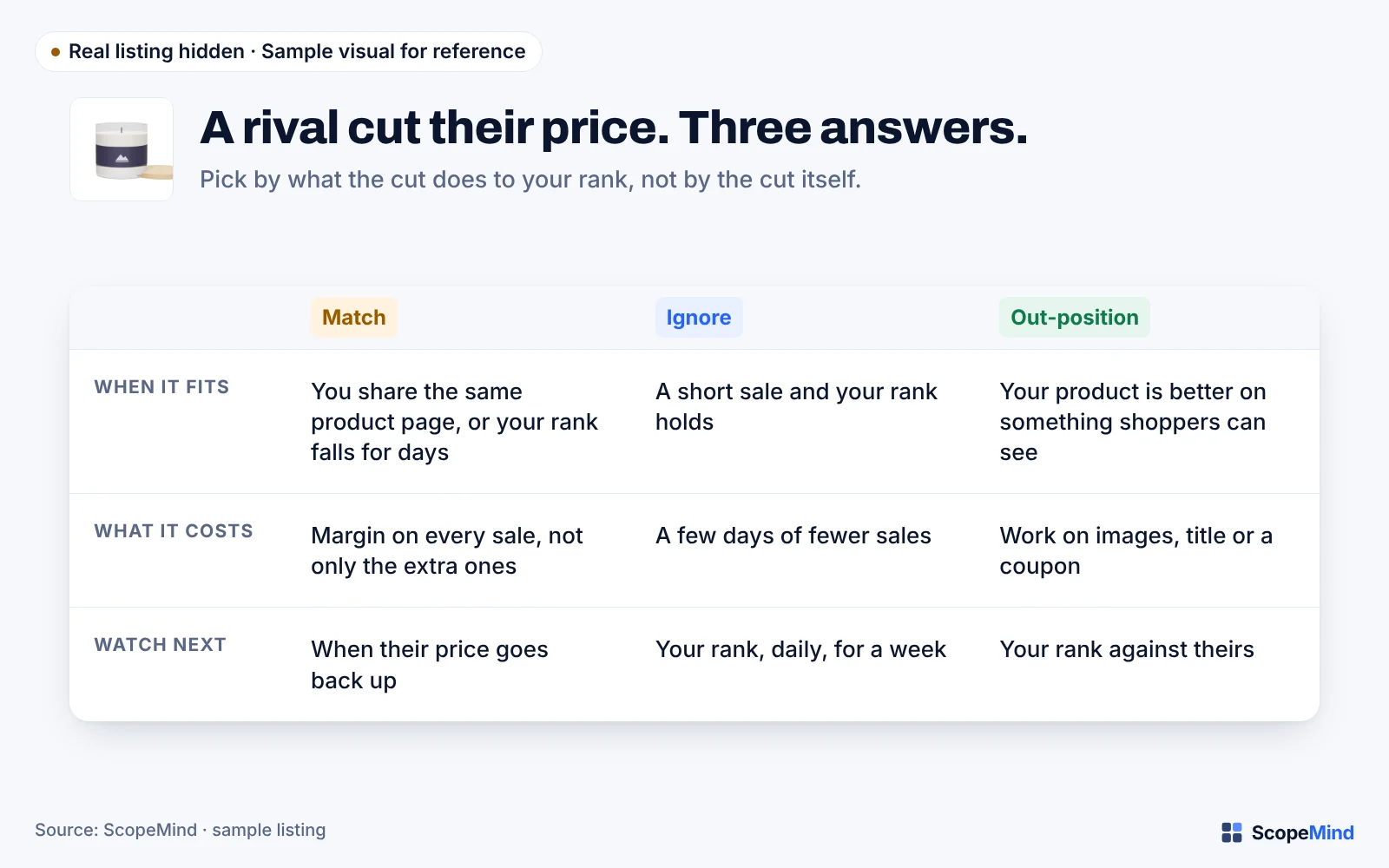
Each answer fits a different situation, and each has a different cost.
| Answer | When it fits | What it costs | What to watch next |
|---|---|---|---|
| Match | You sell on the same product page, or your rank keeps falling | Margin on every sale, not only the extra ones | The day their price goes back up, so you can follow |
| Ignore | A short event sale and your rank holds | Possibly a few days of fewer sales | Your rank, daily, until the sale ends |
| Out-position | Your product wins on something shoppers can see | Work on images, title, a coupon or a bundle | Your rank against theirs over two weeks |
When is matching the price the right call?
When you sell the same product on the same page, or when the cut is clearly taking your sales.
If several sellers offer one product, the price is compared directly in front of the shopper, and a lower price with similar delivery can move the featured offer to someone else. There, waiting a week can cost more than matching.
On your own brand, match only after the rank log shows a real drop. Set a floor before you start, so a chain of cuts cannot pull you below the price where you still make money. Amazon's Automate Pricing tool, free with the Professional selling plan, can follow a rival's price within a minimum and maximum you choose.
How do you out-position a cheaper competitor?
Make the difference in price look worth paying, with changes shoppers see in search.
- Check the main image. In search, the image is often the first thing compared. Show the product clearly and at a good size.
- Name the benefit in the title. Size, scent, count or burn time: whatever makes yours the better buy should be easy to see.
- Use a small coupon instead of a big cut. A coupon shows in search and can be switched off after the event, without changing your list price.
- Offer a bundle. Two of your product, or a set, gives a lower price per item without cutting the single price.
- Measure for two weeks. Compare your rank with the competitor's before and after, not only your own sales.
Can you track competitors' price changes on Amazon?
Yes. You can check product pages by hand, or let a tool record every price change for you.
Checking by hand works for two or three rivals, but it misses cuts made overnight and the day the price goes back up. ScopeMind records the price, coupon and Best Sellers Rank of every product you track, yours and your competitors', and puts each change on one timeline, so you see the cut, its effect on your rank and its end in one place.
After the event, look back at the log. Which rivals cut, by how much, and for how long? That record makes next year's sale week easier to plan.
Frequently asked questions
- Should I always match a competitor's Black Friday price?
- No. A sale that ends after the event often costs you less in lost sales than matching costs you in margin. Match when you share the same product page, or when your own rank keeps falling for several days.
- How long should I wait before reacting to a price cut?
- Watch your own rank and sales daily for the first few days. A short dip that recovers needs no answer. A drop that keeps going for most of a week is a sign the cut is taking your buyers.
- Can Amazon change my price automatically when a competitor does?
- Yes, if you set it up. Amazon's Automate Pricing tool is free with the Professional selling plan and adjusts your price by rules you choose, within the minimum and maximum you set.
- What can I do instead of cutting my price?
- Give shoppers another reason to pick you: a clearer main image, a title that names the benefit, a small coupon, or a bundle. These cost less than a price cut on every sale and keep working after the event.
- When is Black Friday on Amazon in 2026?
- Black Friday is Friday 27 November 2026. Amazon's US Black Friday Week runs from 19 November to Cyber Monday, 30 November, so many sale prices start a week before the day itself.
See every competitor price cut the day it happens
ScopeMind tracks price, coupons and rank on your products and your competitors' every day, next to every listing change.
Start tracking your listings